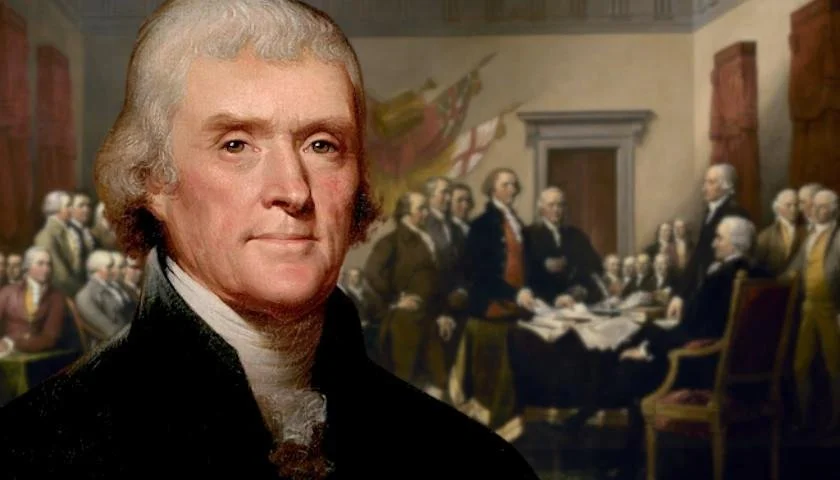
Thomas Jefferson -
Architect of an Early American Paradox
Thomas Jefferson, the third president of the young republic, doubled the nation’s territory through the Louisiana Purchase from France. With this acquisition, the United States expanded from the Atlantic coast to the Mississippi River and across the vast Missouri Basin and Great Plains.
Jefferson then authorized an exploratory expedition into this newly acquired territory, appointing Meriwether Lewis and William Clark to lead the Corps of Discovery to the Pacific Ocean. Their journey from 1804 to 1806 had profound geographic, scientific, and political consequences. The expedition mapped vast territories, documented previously unknown plant and animal species, and established contact with numerous Native American nations. The young republic gained knowledge of the Pacific Northwest and strengthened its claim to western lands.
Jefferson viewed the Louisiana Purchase and the expedition as opportunities to expand landownership, individual liberty, and national sovereignty. In his vision, abundant land would secure the independence of citizens and ensure the long-term stability of the republic.
Yet what represented freedom and opportunity for white settlers posed an existential threat to Native American nations. Westward expansion brought displacement, the spread of devastating diseases, resource exploitation, and increasing pressure from settlement in the years that followed. The encounters between the Corps of Discovery and Native peoples reflected a complex reality: moments of cooperation and alliance existed alongside episodes of suspicion, theft, broken promises, and confrontation.
This dual development—advancement and empowerment for some, dispossession and danger for others—formed one of the earliest American paradoxes. Jefferson proclaimed that “all men are created equal,” yet the expansion of liberty under his leadership did not extend equally to all. When combined with the persistence of slavery and assumptions of white supremacy, this contradiction became a defining tension in American history—one that continues to shape debates about equality, justice, and national identity today.